Lesson 1: The Plan
The Plan is the core abstraction in uberjob.
It represents a symbolic call graph (not an instance of an execution).
As a result, it can be inspected, it can be run multiple times, and it can be transformed in various ways.
It’s similar to a SQL query in this regard.
Example 1
Symbolic calls are made with call(), and symbolic calls can be inputs to other symbolic calls.
call() will raise an exception if the provided arguments can’t bind with the function.
Note that its signature is similar to concurrent.futures.Executor.submit().
A Plan can be run using uberjob.run(), which will only do what’s necessary to compute the requested output.
It won’t do anything here if output is not provided; this concept is known as pruning.
>>> import operator
>>> import uberjob
>>>
>>> def area(width, height):
...     return width * height
...
>>> plan = uberjob.Plan()
>>> x = plan.call(operator.add, 1, 2)
>>> y = plan.call(operator.add, 3, 4)
>>> z = plan.call(area, width=x, height=y)
>>> uberjob.run(plan, output=z)
21
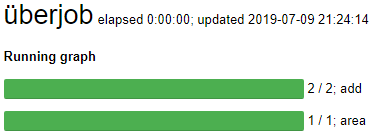
The run() call above also displays the following progress widget.
Jupyter Notebook, HTML, and console progress options are available in uberjob.progress and can be specified using the progress argument.
Multiple can be specified at once.
When not running in Jupyter, the console progress is used by default.
A Plan can be rendered using uberjob.render().
The render function is a great tool for understanding how uberjob works.
>>> uberjob.render(plan)
add_dependency() can be used to add non-argument dependencies.
This is useful when side effects are involved.
Note that uberjob.run() will raise an exception if the Plan has a cycle.
>>> plan.add_dependency(x, y)
>>> uberjob.render(plan)
Example 2
Non-symbolic arguments passed to call() are automatically made symbolic using gather(), which is covered in a later lesson.
For now, assume they are converted to symbolic literals.
Literals can be created explicitly using lit().
The return type of call() is Call and the return type of lit() is Literal.
Instances of both of these classes are called nodes.
Nodes are simple classes and their contents are easily inspected.
A pair of nodes can have multiple edges between them, making the underlying data structure a multidigraph.
The actual networkx graph can be accessed using uberjob.Plan.graph.
>>> plan = uberjob.Plan()
>>> x = plan.lit(7)
>>> y = plan.call('{}{}{a}{b}'.format, x, x, a=x, b=x)
>>> uberjob.run(plan, output=y)
'7777'
>>> type(x)
uberjob.graph.Literal
>>> x.value
7
>>> type(y)
uberjob.graph.Call
>>> y.fn(1, 2, a=3, b=4)
'1234'
>>> uberjob.render(plan)
Recap
To summarize, the Plan is used to build a symbolic call graph which has two node types and three edge types.
Node types
Edge types